- 发布日期:2026-09-18 16:19
- 访问次数:
- 来源:
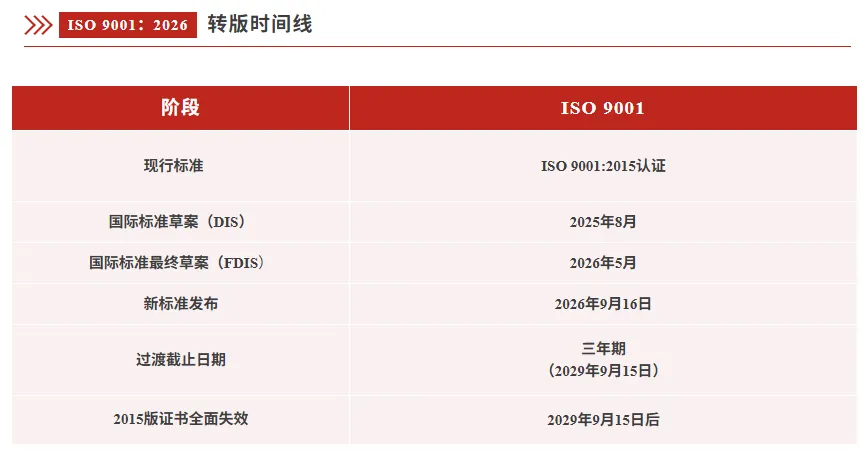
On September 16, the International Organization for Standardization (ISO) officially released ISO 9001:2026 "Quality management systems — Requirements" on its official website. This is the first systematic iterative upgrade completed after more than a decade of industry practice since the implementation of ISO 9001:2015. The new version fully retains the ten-chapter logical framework of the High Level Structure, while making targeted responses to real-world needs emerging in global industrial operations over the past decade, such as digital transformation, supply chain risk prevention and control, and sustainable development. It formally incorporates long-term additional topics such as organizational resilience building and uncertainty response into the core constraints of the quality management system, promoting the system's positioning to shift comprehensively from traditional compliance orientation to strategic value orientation that supports an organization's long-term stable operation.
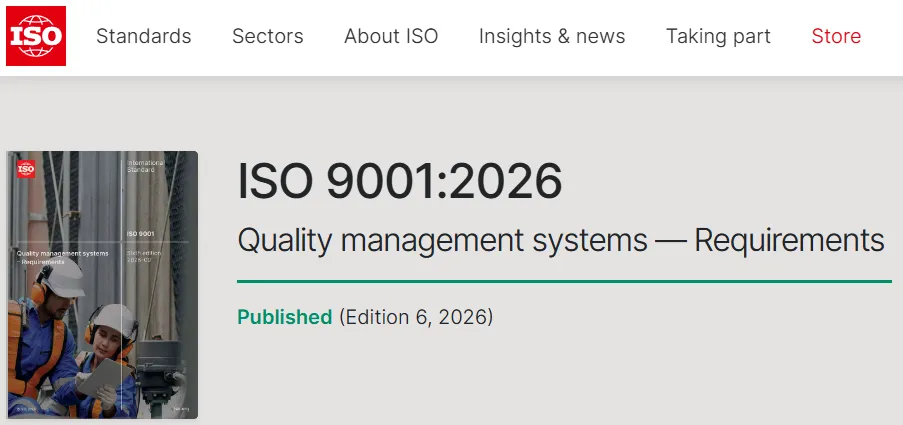
As the current core quality management standard in its sixth global iteration, the ISO 9001 framework system has gained long-term application and trust from more than one million organizations worldwide. The 2026 revision further improves the standard's ease of implementation through targeted clause optimization, ensuring that this management system, born many years ago, still possesses sufficient practical guidance value in today's rapidly iterating digital business environment.
ISO 9001:2026 was officially released on September 16. One of the core directions of this revision is to strengthen the clarity of clause wording, helping organizations of different sizes, different management maturity levels, and different business attributes to more accurately understand the various requirements put forward by the standard. The new version highlights the core position of quality culture building and management responsibility, and at the same time splits the previously combined expression of "risks" and "opportunities" in the original standard into independent management modules, guiding organizations to shift from passive prevention and control of problems to proactive layout and anchoring beneficial outcomes of high-quality development.
In addition, this revision further strengthens framework coordination with other ISO management system standards. Regardless of the organization's industry or size, integrating ISO 9001 into its existing integrated management system is smoother and more convenient than with any previous version.
Previously, Certification Jun compiled and analyzed important changes, enterprise action recommendations, core value, and other content of the new ISO 9001:2026 standard.
Important Changes in the New ISO 9001:2026 Standard
The key changes in this standard are mainly concentrated in the following aspects:
Consider the impact of climate change
Strengthen quality culture and ethical behavior governance
Focus on seizing opportunities
Strengthen the effectiveness of change management
Focus on knowledge sharing
Strengthen supply chain and operational monitoring
Focus on objective setting for internal audit
Strengthen attention to management review inputs
Enterprise Action Recommendations
At present, the 6th edition of ISO 9001 has been officially released. It is recommended that enterprises immediately initiate the following work:
Verify existing gap analysis: Use existing tools to assess the conformity of the current management system with the new standard;
Develop a transition timeline: Clarify the key milestones for training, process adjustment, and certification application;
Pay attention to professional guidance resources: Seek professional support from authoritative institutions to ensure efficient implementation of the transition work.